Moments after pulling in to the far parking lot at Great Falls by the platform tennis courts and seeing the minivans and SUVs with stickers in the rear windows from Loomis Chaffee, Woodberry Forest, Georgetown, and UVa, and also stickers supporting both presidential candidates, and seeing the tents set up and the bleachers full of young tennis fans, it takes Anne no time at all to remark, “We’ve forgotten the sunscreen.”
Anne is paranoid about the sun and not without good reason: three years ago she had a basal cell carcinoma removed from just beneath the left side of her jaw. She and Kate are fair and seemingly more vulnerable than Thomas and I who, with our mystically-received Moorish genes from my mother’s Norwegian ancestors, have curly dark hair and skin that tans well without burning or freckling. (The original Ericksons apparently enjoyed sailing the warmer climes.) Anne and I remember both being in college in Chapel Hill stretching out on beach towels on the tiny strip of grass at Connor Beach, our bodies soaked in baby oil and surrounded by cardboard wrapped in tin foil, listening to the Talking Heads and Superchunk and R.E.M. coming from a handheld stereo broadcast from WXYC right across the street. That was probably when most of the damage was done, outside of her childhood on the cape, but the scare was real enough and we take it seriously now, carrying around spare bottles of sunscreen in the glove compartments or travel kits of both our cars (60+ SPF) and never letting the children out of our sight without a quick spritz.
“I’ll take a look,” I say. “I may have some in the back.”
My golf clubs (second-hand) and shoes (well-worn, first generation Foot-Joys) are sandwiched in the cargo area of the wagon along with a stack of wool blankets (in case of a snowbound crisis), a size 7 Winston fly rod in its protective olive green case (more than worth the money I paid for it, I’d say—based on its current appearance, the rod would have been beat to hell and back by now), an old Wilson football in need of air, my running shoes, a copy of an engineering journal with an article on solar-powered tree houses, an emergency road repair kit, a chewed-up, fluorescent green Frisbee (Pepper’s) that pulls to the left when you throw it, and the cooler we took to the farmer’s market. The ice in the cooler has started to melt and the chicory and the asparagus is floating on top alongside six recycled plastic bottles of kefir and two gallons of organic, hormone-free skim milk in glass containers. The jar of unprocessed raw clover honey has sunk to the bottom of the cooler under its own weight.
“No dice,” I say.
“Well,” Anne says. “We’ll have to cut it short. And we’ll have to wear the hats.”
Kate and Thomas take their time getting out of the wagon: Thomas is still reading his folded-up paperback, the earpieces of his iPod still wedged into his ears (I can never tell if the thing is actually on; he wears them around the clock solely to avoid conversation) and Kate is fixing her sunglasses and massaging her hair into place (she has Anne’s hair; it’s uncanny how the two of them could be fair-skinned, freckled twins). I study them emerging from the backseat and stretching—Thomas in his baggy skater shorts and tee-shirt covered with graffiti (he has a growing collection of band tee-shirts in black though this one is white with a picture of two stylized guitars crossed at his sternum); Kate in a beige skirt and pink polo—as though they are someone else’s children, someone else’s beautiful children, more beautiful than anything I could ever begin to take credit for, standing with someone else’s stunning, ageless wife, (in her white tennis skirt and her knit shirt from Roland Garros that shows off her shoulder caps and a pair of pristine Stan Smiths) who on any other planet would not be caught dead with the likes of me.
Tuesday, April 28, 2009

Sunday, April 26, 2009
Stratford Landing
Otherwise the drive was not unpleasant. Co-eds were out in force in their cut-off shorts and tank tops and sunglasses and also in tennis and running shoes that gave their step and their pony tails an extra bounce. Graduate students were studying outside coffee shops and under shade trees in little open squares like Stratford Landing (that halfway reminded me of Paris) with books open across their knees or in their laps. Young mothers were pushing strollers with Sunbrellas, and over the ether, a newscast on the casualties in Basra was pleasantly cut short in favor of the Louvin Brothers.
It is a crystal clear day with almost zero cloud cover, save for some contrails that have split the sky and dissolved, and quite warm even for late-May. It is after all the kind of day that makes you think of sunscreen—or sunburn—and global warming almost instantly: wisteria in the air now and the trees and shrubs are Technicolor green. The Northern Lights and the Brick Ruffles (my favorites) and the Jack Sands are all in bloom now despite last year’s drought (they step down in great sweeping cascades of color across our lawn and the lawns of our neighbors), though too late for Easter, when the children of St. Aidan’s process from the chapel to the church and up the aisle to place fresh flowers at the base of the wood and wire cross until the altar is overflowing with color.
This year for Easter we were given a surprisingly adult dose of sleet and snow that began on Good Friday and ran through to Easter Monday (which is of course no longer a holiday). We lost power once or twice over the weekend, became fully dependent on wood heat and candle light, and the morning services were canceled.
At the evening service gone were the awkward, sheepish “alleluias” from Lent: they were replaced instead with an echo of silence after Father Reynolds pronounced the Resurrection, as though the utterance of praise had finally been drummed completely out of us and for good. The children’s processional was cut in half due to black ice on the brick sidewalks out front, so the children stood (in their dungarees and down vests and leather boots) in the narthex until they were signaled to begin. Tromping lead-footed down the aisle the children put the frozen nubs of bulbs and sprouts and bruised flowers on the altar anyway, and while the sentiment was there, the resulting effect was a deep, deep grayness and dreariness that made my heart sink.
We had long desired the release of spring and warmer weather and we received instead an extended sentence in a purgatorial winter. Even Reynolds must have felt it a week in advance. He must have known ahead of time that we were rushing headlong into conflict with nature, given his phoned-in sermon about a popular novel and film that had called into question the celibacy of Christ and the actuality of his death, and by extension his resurrection. That Reynolds felt this current, but fleeting, cultural icon was something that needed addressing further in the public dialogue was somewhat of a surprise to many of us and indicated that either a) we had vastly overestimated the intelligence of our fellow seekers, our Christian brethren or b) the good Father himself just wasn’t feeling it.
His must be a difficult yoke to wear day in and day out.
In short, everything about the day was the opposite of the renewal and the rebirth that I and so many others had been looking for after our long and painful exile in February. We had all (some more so than others) been clock-watching and calendar-turning for weeks now, looking for something to break apart and give way, and the sound of the frozen precipitation pinging the stained glass windows during the confession of sins made me want to cry.
But today. Today is the day. Today is the day we are shedding that dark robe of death. We are shedding that heavy, heavy mantle of destruction and despair and trading it in for Bill Monroe, for Foggy Mountain Breakdown, for the Osborne Brothers, for the Sunday Times and for the Post, for tennis in the afternoon, later for some gin, and perhaps some grass-fed steaks on the grill.
Saturday, April 25, 2009
Another Sunday
ANOTHER SUNDAY.
A holy day for most people, our family typically included, though on a morning like this you just might doubt it, judging by the way we slept late (until almost ten!), drove about aimlessly spending money (eating brunch at the French bakery in Reston, reading the papers, and squirreling away the last stalks of the spring asparagus and the dregs of the chicory at the farmers’ market down in Dale City). Later we will put up a new batch of lost-and-found signs the children made on the Mac (with the iconic paw prints and broken hearts and falling tears), and then fritter away the remainder of our weekend at the club at Hollow Rock.
We managed to avoid St. Aidan’s like the plague, though in all fairness the evasive action was probably overkill. We’ve known Father Reynolds and his wife Linda for years: she and Anne play tennis together once a week (even though Anne is a 4.0 and Linda is at best a 2); he and I have been known to hunt ducks together down in Ocracoke, drink gin and argue (Anne and Linda call it “playfighting”) over the global economy, the war, gays in the Anglican church, and John Courtney Murray. Reynolds, like many Episcopalians, is an ex-Catholic and studied Murray at Weston (before meeting Linda in Cambridge and falling in love with her). I guess that’s what gives him the right, as much as anything else.
I took an elective many years ago, went to business school, and so I am allowed to fake it, and I do so fairly well, especially after a few gimlets. Reynolds is older than the both of us, by ten years at least, and maybe that much or more older than Linda who is of indeterminate age owing to pilates and an expert colorist. But Reynolds loves his wife and his parish, he shoots straight and well, and with respect to most things, I believe, he has his priorities sewed on straight, with the sole exception of a mean streak when it comes to same-sex marriages.
Of course Reynolds knows our children too (he baptized them both) and he knows our wagon and our coupe (the aging three-series convertible Anne still calls her “ride”). And though he, like any good rector worth his salt, wouldn’t give a flip one way or the other if we were in attendance, I still drove us several blocks north out of our way and then doubled back down 628 to get us heading south on 1, figuring on a clean getaway. When we got to Riverside, however, close enough to the church we could see it and its flock of seekers corralled under the sycamores down a narrow side street, Anne reached across—here I was overcome by the smell of her shampoo in her newly-washed, still damp, fair-and-not-yet-graying hair, and her perfume, a French name with two accents, one of each, ague and grave, and several “e’s”—and honked the horn, throwing our too-cool-for-school Kate into a full-on, rolling fit of hysterics.
Friday, April 24, 2009
Sunspots
There have been sunspots lately and we have been lucky to pick up stations from from the Midwest and New England, getting the news from the Grapefruit League and from all over, even a station that Anne (who took Spanish at Chapel Hill and volunteers legal services to a local community of migrant workers) swore was from Matamoros. This morning, nothing too exotic: WBRF out of Gretna, streaming gospel and old time music, and prompting a nearly instant spout of sarcasm from Thomas in the back seat.
“AM radio, Paul?” he says. “Seriously, have you ever heard of digital?”
It is an unfortunate state of affairs that we are no longer, and haven’t been for some time, “Mom and Dad.” Kate started calling Anne and me by our first names when she was seven and thanks to our reluctance to discourage her precocious streak, the affectation has stuck, sadly, ever since, Perhaps the only thing to successfully stick with our youngest offspring.
I did Scouts with Thomas for three years, collecting badges and Jamboree-ing until we were blue in the face. We did slot car racing and ice hockey and archery, rocket ships, fingerprinting, photography, coin-collecting, cooking, radio building and even fly-tying using a sheaf of feathers Father Reynolds provided us from a recent pheasant shoot, but nothing seemed to grab on and hold. I did, however, get a decent short wave radio out of the deal and can now, on clear winter nights sitting by the fire place with a glass of Oban, pick up Stockholm, Montevideo, and Medicine Hat.
Then, in middle school, Thomas fell into music, and it has seemed to stay with him. I attribute his sustaining interest less to the music itself than to the many accoutrements that famously come with the territory: picks and strings and amplifiers and effects pedals, gear bags and cords, and of course the possibility of female attention. At the first sign of interest I offered him my old Martin dreadnought but he recoiled at the very sight of the acoustic guitar and after some haggling we agreed together to split the cost of a used Gibson electric.
Now he plays in a cover band (“Spyware”) and though the only song he knows all the way through from opening riff to bridge to coda is “Black Dog,” he is all about “fidelity.”
Fidelity of sound, I suppose, but not fidelity of feeling or fidelity of purpose. He has a ways to go before then.
“Dig-what, Sonny?” I use my best crotchety old-man voice and turn up the static and the old-time fiddle until I am afraid I will blow the speakers. Anne holds her ears; Kate, her nose. But “Rocky Top” never sounded so good.
“What’d you say? I can’t hear you; I must be going deef.”
“Whatever,” he says, and puts his nose back into his paperback book, a tell-all biography of an mostly unknown 1960s hard rock band from the Netherlands known to a select few connoisseurs for once upstaging Led Zeppelin in a tour incident involving a monkfish, a pair of Italian nuns and a water gun filled with booze.
Saturday, February 28, 2009


Friday, February 27, 2009

Wednesday, March 19, 2008

Thursday, December 27, 2007

Wednesday, August 22, 2007

Wednesday, August 15, 2007

Tuesday, April 03, 2007
Palm Sunday
The fountains are dry; pollen is caked in the pocked concrete of the driveway, and in the animals’ fur. Lia takes the Christmas lights off the Japanese maple. She is afraid they will hurt the little tree somehow. Palm Sunday. The sung Passion of Luke. Absent are the awkward, errant “alleluias” from the first few weeks of Lent. In a week, the children will cut azaleas and irises to take with them to the altar. We leave early, Isabel and I, to get Catherine’s medicine. Her fever is down but not by much.
“It’s my fault,” I say, “for not fixing the fence sooner.”
“Don’t do that to yourself, Papi,” she says. I forget she is only five.
We make signs, Isabel and I, the largest font reserved for “LOST.” I spell it for her, forgetting she is already five.
I drive around stuffing mailboxes, the wisteria in the air.
We sleep off and on during the day recovering. Watch a movie. Eat dinner. Are up again all night.
“‛There are wolves on the lawn.’” Yes. I like it very much. But it’s already taken.
Wednesday, March 14, 2007
Gig @ Network World
For the next month, I’ll be doing a guest blog at Network World. I am grateful for the opportunity and hope to use the spot to generate some discussion around green initiatives and service providers, and around green data centers in general. Please check it out at:
http://www.networkworld.com/community/?q=williams
http://www.networkworld.com/community/?q=williams
Saturday, September 16, 2006

Saturday, September 09, 2006

Monday, May 01, 2006
Mayday
Mayday
I feel as though I have been too hard on the kids, the dogs. My favorite word is No or Nunca. No don’t play in the fountain. Nunca. No don’t bludgeon the roses or the lavender or the guara. No tocar. Something is either sucio or peligroso or both. I take the dogs for a hike to the stream.
Heel. Sit. Sit. SIT. Heeelll.
I think I see a snake roiling in the shadows of the deep end of the stream, long after the dogs have decided to lie down in it and drink.
Come. COME. CUHMME.
It’s a beautiful night two nights in a row and together we show Isabel how to roast marshmallows over the fire pit (clearly an activity both dirty and dangerous) and she has a swell time.
I wake at two A.M. for a six A.M. flight. I haven’t traveled in a few months—since the move, I have been on a plane twice—and my internal clock is clearly way off. I toss and turn in bed trying not to move much, trying not to wake the dogs. At four I wake and before showering I take the dogs outside. They void themselves and then stretch out on the back porch in the darkness.
Lia tells me that she heard Isabel take herself to the bathroom in the middle of the night. I am proud of this but also saddened by it. Proud that she feels at home in the new house now, that we have made a space for her in which she feels safe and secure enough to walk about in the middle of the night. Saddened, of course, because she will soon be five and also because today she is registered for kindergarten.
It’s a beautiful night and the children are riding their bikes and scooters on the deck. The sunlight is failing and the temperatures are falling. I am wearing a sweater and it is time for bath and bed.
Isabel, come on in. Time for bath.
Dad, you are so predictable. You always make us not be out here.
Friday, March 24, 2006

Friday, March 17, 2006
Wan Kenobi
Isabel says we should name the baby “Wan Kenobi.” I think she would spell it “Juan Kenobi.”
Friday, February 17, 2006
Tremendous Source of Inspiration
Three days after I arrive home I get the following email:
Dear Mr. Williams,
It was indeed a pleasure having you stay with us during your recent visit to Bangalore.
We thank you for sparing your valuable time to complete our Guest Questionnaire, which has been forwarded to us by our Chairman for action and response.
It is motivation from discerning patrons such as you, which encourages us to give our best. It has also been our utmost focus at The Oberoi, Bangalore to provide our valued guests with personalised service that meets high standards of hospitality.
I have conveyed your gracious compliments to Sreeram, for whom it has been a tremendous source of inspiration.
I look forward to the pleasure of your continued visits and assure you of our best services at all times.
Thank you,
Yours sincerely,
[name deleted]
General Manager
The Oberoi, Bangalore
The Emerald Route
Delayed for a few weeks in jotting down the following:
Leaving Bangalore tonight on the 2:30 AM flight back to Frankfurt. Total flight time between here and home, 22 or so hours. I buy a copy of “The Emerald Route” by R.K. Narayan at Hal Airport and skim a few pages while watching a TV special about the inherent insecurity of India’s security forces.
I stumble on the following passage about Bangalore:
“The hoary nucleus of the city retains an indescribable charm, although the architecture may look outdated, and one’s passage at first may appear hazardous through it’s traffic, but actually the wheels steer off within a hair’s breadth and spare the pedestrian’s toes, who must survive by lightly leaping aside, and recovering his balance from the very edge of the granite pavement, and may not suffer more than an occasional jab from a cycle handle or a bump from its mudguard as crack-riders dash past, weaving their way through.”
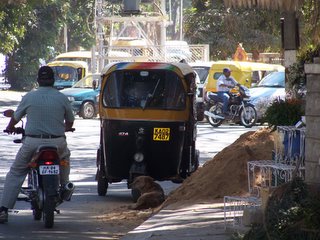 This was 1977 of course, when Narayan was writing, before the advent of the autorickshaw which is by far the most prevalent vehicle on the streets of Bangalore. 75,000 of these or so are registered with the city government, but estimates of actual numbers on the streets range into the multiple hundreds of thousands. This was 1977, when the population of Bangalore was just over two million, while today it is greater than six million.
At no time did I ever feel safe crossing the street or riding in a car, though my driver, Anish, was a consummate pilot: calm and cool, and often quite strategic in his lane swapping and vehicle passing. Most of the time, however, I kept my eyes closed. When I commented multiple times on the traffic, I was told that if you ever doubted the existence of a higher power, go to India and watch the traffic work - it just works - inexplicably.
I sleep on the plane a few hours, then wake up and become completely absorbed in a Bollywood flick, No Entry, which is mysteriously captivating.
All is well until I eat something on the plane that in turn has me waylaid for the next three days.
Leaving Bangalore tonight on the 2:30 AM flight back to Frankfurt. Total flight time between here and home, 22 or so hours. I buy a copy of “The Emerald Route” by R.K. Narayan at Hal Airport and skim a few pages while watching a TV special about the inherent insecurity of India’s security forces.
I stumble on the following passage about Bangalore:
“The hoary nucleus of the city retains an indescribable charm, although the architecture may look outdated, and one’s passage at first may appear hazardous through it’s traffic, but actually the wheels steer off within a hair’s breadth and spare the pedestrian’s toes, who must survive by lightly leaping aside, and recovering his balance from the very edge of the granite pavement, and may not suffer more than an occasional jab from a cycle handle or a bump from its mudguard as crack-riders dash past, weaving their way through.”
 This was 1977 of course, when Narayan was writing, before the advent of the autorickshaw which is by far the most prevalent vehicle on the streets of Bangalore. 75,000 of these or so are registered with the city government, but estimates of actual numbers on the streets range into the multiple hundreds of thousands. This was 1977, when the population of Bangalore was just over two million, while today it is greater than six million.
At no time did I ever feel safe crossing the street or riding in a car, though my driver, Anish, was a consummate pilot: calm and cool, and often quite strategic in his lane swapping and vehicle passing. Most of the time, however, I kept my eyes closed. When I commented multiple times on the traffic, I was told that if you ever doubted the existence of a higher power, go to India and watch the traffic work - it just works - inexplicably.
I sleep on the plane a few hours, then wake up and become completely absorbed in a Bollywood flick, No Entry, which is mysteriously captivating.
All is well until I eat something on the plane that in turn has me waylaid for the next three days.
Subscribe to:
Posts (Atom)

 Posts


